On November 11, 1918 at 11 a.m., World War I came to an end. An armistice was declared and both sides stopped fighting. No peace treaty was signed, but soldiers from Germany, France, England, the United States and other countries went home. The war was over. “The Great War” – officially ended when the Treaty of Versailles was signed on June 28, 1919, in the Palace of Versailles outside the town of Versailles, France.
The following November in 1919, President Woodrow declared November 11 as the first commemoration of Armistice Day, acknowledging the end of the fighting and honoring those who fought. On May 13, 1938, Congress made Armistice Day an official national holiday set aside to honor veterans of World War I. Following the massive mobilization of troops for World War II and subsequent service by Americans in Korea, Congress amended the original Act to include all veterans of the U.S. military, the name changing from Armistice Day to Veterans Day. So today, we take time out on November 11 to remember all of our soldiers, sailors and aviators who have served our country.
But there is one thing about that original Armistice Day that needs explanation. We all know that during the Civil War Union soldiers were nicknamed Billy Yank and Confederates Johnny Reb. During World War I, Americans in Europe had a nickname too, Doughboys. The origin of the term applied to those soldiers is debatable. Many versions of the history of the word can be found. What we do know is that the term doughboy originated in the 1600’s and described a dumpling-like food. There is some evidence to indicate soldiers in the Mexican War were called doughboys as a result of the white pipe clay they used to clean their leather gear. Civil War soldiers were referred to as doughboys a few time in the written record because, it was said their buttons looked like the dumpling shaped food. But the term never really caught on until World War I.
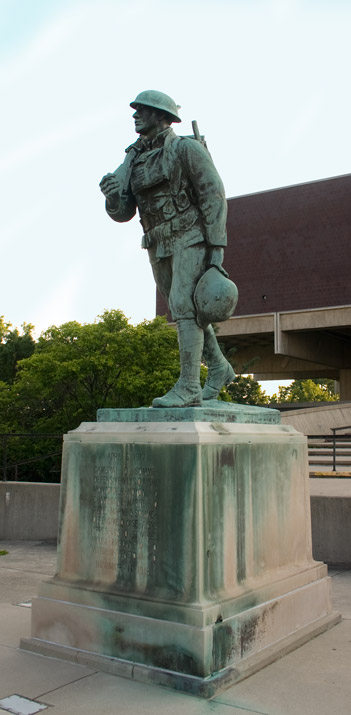
The Doughboy statue at the Ohio History Center in Columbus
One theory has it that U.S. soldiers in the Philippines became so dust covered the looked doughy. Another claims the term was one of derision by the French and British troops toward the newcomers to a war they had been fighting for four years. Regardless of where it came from, it stuck (pun intended). The term ‘Yank’ so popularized in the song “Over There” was pushed aside as U.S. troops wrote letters home calling themselves doughboys. The news media picked up on it and even the government began to use the term. Today, it is a label used with affection and proud remembrance. It symbolizes the courage and determination of 4,355,000 men who served during the “Great War.”
No responses yet