On Friday, June 6, we will commemorate the 70th anniversary of the D-Day landings on the north coast of France. Sadly, many people under the age of 30 don’t know what D-Day is. Just as concerning is the fact that even many older than 30 only have a dim understanding of the significance of that day. It was a day two and a half years in the making for the United States. When the Japanese attacked Pearl Harbor on December 7, 1941, the United States entered World War II. What happened over the next 30 months was nothing short of amazing. The country mobilized for war like it never had before. Not since the Civil War had the country experienced such a complete war economy and society. While young men enlisted and began training for an eventual move to the Pacific, North Africa or England, women moved in to factories to build war machines and material. When landing craft dropped their ramps on Utah and Omaha beaches that day, it was the culmination of an entire nation’s determination, skill and faith in each other.
In some of the large craft came jeeps from Toledo and tanks from Lima. A variety of uniforms and equipment worn by the troops were made in Ohio. In the pockets of those uniforms were photographs of loved ones, as well as cherished letters from home. One of those soldiers was Lieutenant Frank Bergstein of Cincinnati, commander of the Headquarters Company for the 115th Regimental Combat team. Their boat coming ashore at Utah Beach, Bergstein described the landing this way.
“As we circled around, the shelling intensified and we also came under fire from machine guns and mortars. I didn’t think we were going to make it, and I thought to myself, “My first combat decision and I’m afraid it’s going to be a disaster.” Miraculously, we came pretty close to the shore without receiving serious hits. I ordered one man ashore with a rope and I went next. We were still in about five feet of water, but everyone in the boat managed to get safely ashore.
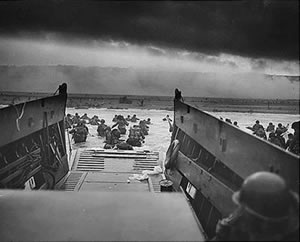
Then there was John “Jack” Gabriel of Strongsville who never talked about the war until late in his life. Jack recalled the horror of the landings on the beach. As the ramp dropped on their boat and the bullets began to pour in he saw,
“There was guys lying all over the place. Guys from my outfit,” he said. “I says to myself, ‘God almighty, what the hell am I doing here?’ I says, ‘I’m dead.’ I says, ‘I’m going to die here. It was bad. I lost about everybody I knew. I seen guys who’d been blown up, all around me. I’m actually going through that. I don’t know how. But that’s why I don’t like to talk about it.
Only 45 of the original 220 men in Gabriel’s unit survived the assault.
Of course we know that the courage and sacrifice of those soldiers should be honored. Likewise, we should not forget the tireless work of everyone at home turning out war materials and keeping the country going. But, I think we have a larger obligation that speaks directly to us 70 years later. Ours is to do the work that many of our fallen would have done. To do great things and good things in our lives. To fulfill the opportunity they provided for us. We don’t often think of the thousands of unborn children as a result of those lost in battle. That lost chance for those men to contribute to our society by raising families and continuing the traditions of a democracy in a free country. To meet that obligation, we have only to live our lives each day as they lived theirs while in uniform. Committed to freedom and each other. Valuing the man beside them as much as themselves. Doing their jobs without need for recognition or fame. Very few of these men would have been famous had the war not come. But they did not wish to be. They simply saw the need and filled it. For that, we should always care about D-Day.
One response
Very reflective. Nicely done.