I have been waiting all year to write this article. As a historian, I sometimes get annoyed at the collective myths that have evolved over time in regards to our history. None more so than the myth of the first thanksgiving.
Let’s begin with the events of 1621 commonly described as the Pilgrims first thanksgiving. That first harvest feast was a feast at harvest time. The tradition was brought with the Mayflower travelers from England. It was a feast celebrating the successful completion of harvest. Nowhere in the writing of those settlers is the term thanksgiving used, not even ‘giving thanks.’ It did not occur in late November, but rather would have been in mid to late September, certainly no later than early October. And the main course was not turkey, but ducks and geese. The writings of the Plymouth settlers clearly states that “Our governor sent four men on fowling, that we might after a special manner rejoice together after we had gathered the fruit of our labors.” The record of that first feast does not mention it as a feast of thanksgiving, but rather as one of harvest celebration. In addition to the ducks and geese, the settlers dined on venison brought by Native Americans.
And what of the name ‘Pilgrim.’? The reality is that a minority of the travelers on the Mayflower were coming to America to avoid religious persecution. Most were on the ship to settle a new land for personal gain and adventure. In fact the term pilgrim was not applied to the settlers until about 160 years later … and it was pilgrim, not proper noun and used in its more generic form. Plymouth colony, as their own records show was not a pious community of black garbed, somber inhabitants. Court records and written accounts tell us that they were regular people dealing with the human misbehaviors common to any society.
So when did the first thanksgiving happen and how did we get to where we are? There are two answers to that question. The first national day of thanksgiving was proclaimed by President George Washington on October 3, 1789. The proclamation read in part:
Now therefore I do recommend and assign Thursday the 26th day of November next to be devoted by the People of these States to the service of that great and glorious Being, who is the beneficent Author of all the good that was, that is, or that will be.
(Full text available at http://www.si.edu/Encyclopedia_SI/nmah/thanks.htm#Transcription of George Washington’s Proclamation)
The proclamation did not institute an annual day of thanksgiving, but just for that year of 1789. Several presidents issued similar proclamations the next few decades, always a single year and similar to that issued by Washington. In the 19th century, the national day disappeared, replaced with local and state proclamations at various times throughout the year. While some may have been connected to harvest time, most were proclaimed with a religious giving of thanks.
Now to the establishment of our annual national day of thanksgiving. After the Union victory at Gettysburg in July of 1863, President Abraham Lincoln on October 3 proclaimed a national day of thanksgiving be observed annually on the fourth Thursday of November. The main section of that proclamation reads:
“They are the gracious gifts of the Most High God, who, while dealing with us in anger for our sins, hath nevertheless remembered mercy. It has seemed to me fit and proper that they should be solemnly, reverently and gratefully acknowledged as with one heart and one voice by the whole American People. I do therefore invite my fellow citizens in every part of the United States, and also those who are at sea and those who are sojourning in foreign lands, to set apart and observe the last Thursday of November next, as a day of Thanksgiving and Praise to our beneficent Father who dwelleth in the Heavens.”
(Full text available at http://www.abrahamlincolnonline.org/lincoln/speeches/thanks.html)
Lincoln referred to the harvest time in the proclamation, but the main purpose was one of solemn thanksgiving for the continued existence of the Union. Ironically, while Lincoln’s Emancipation Proclamation is well known, the Thanksgiving Proclamation is the one that Americans commemorate each year.
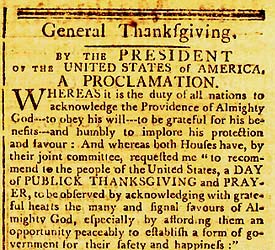
An 1863 newspaper clipping announcing the first Thanksgiving Day.
This time the Thanksgiving Day stuck and was observed annually across the country on that fourth Thursday. That is, until 1939 when President Franklin Roosevelt moved it up one week to the third Thursday. He did so to help the economy by giving merchants an extra week to sell Christmas goods – sound familiar? The same happened in 1940, but people in the nation did not like the move and so Congress, on October 6, 1941 fixed the date as the fourth Thursday through the passage of a law declaring a Federal Thanksgiving Day holiday.
So now we come to today, some 400 years after the first mythical Thanksgiving. Today’s holiday is a mixture of the Plymouth Colony myth, Washington and Lincoln’s vision for a solemn day of profound gratitude, and a generous portion of corporate advertising. Of course, for some Thanksgiving is just a kick-off to the Christmas shopping season. But that is an article for another day.
No responses yet