It was 22 years ago today that history and reality came too close together. The promise of a memorable weekend for nine friends who shared a passion for Civil War history – the 1997 reenactment of the Battle of Antietam in Maryland was one we had been looking forward to all year. Our group, members of the 49th Ohio Volunteer Infantry, had been selected for the honor of color guard for the regiment for the weekend. We would carry and guard the flags through a series of recreated battles. We were color sergeant Tim Landacre, father and son Gus and Thad Gallagher, Nick Wilson, Gary Milligan, Dave Grahl, Mike Geary, Neil Hamilton, and me.
Three days in an army camp living just as the soldiers did. I can still recall the sounds of that massive camp where thousands of reenactors had gathered. I am an early riser, so was up contemplating the coming day when the army awoke on Saturday. The first sound you hear is the drummer at army headquarters. He plays a beat that signals all drummers and buglers to gather for reveille. A few minutes later, bugles throughout the camps wake the sleeping soldiers with the brassy notes. At the end of reveille, the camps are quiet again, but only for a few moments. In hushed tones company sergeants call for their troops to fall in for roll call. Across the expanse of the camp names are called and half-awake responses signify each soldier’s presence for duty. Shortly after, fires come to life in each company street as coffee is brewed and breakfast cooked.
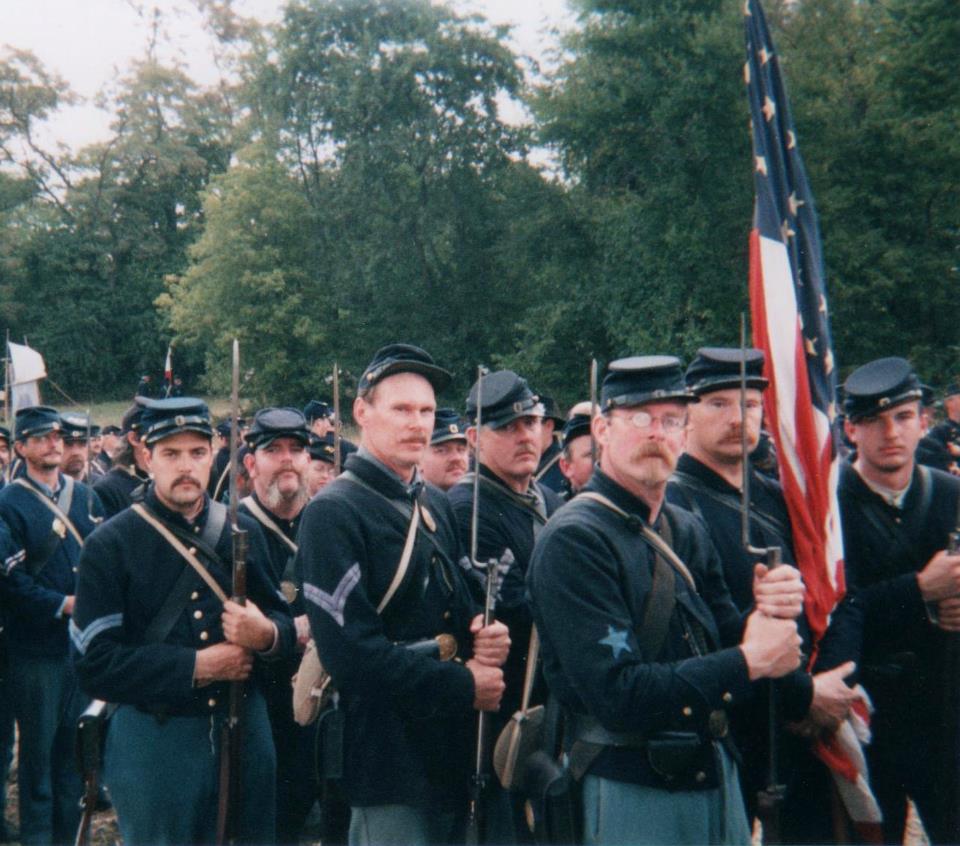
The Color Guard, Tim Landacre wearing the star
About mid-morning the army takes to the field for drill – army practice if you will. Marching about to perfect our maneuvers that will be used that weekend in the battles. This is our first look at the army together and it is impressive. We drill as a brigade of three regiments, a quarter-mile wide when in line end to end. After lunch, we march to the battlefield and engage with the enemy while spectators watch and get just a sense of what it was like during the war. For us as color guard, being in the middle of the battle and proudly defending the colors was special for we knew that, during the war, many a soldier had died for the privilege of guarding his regiment’s flags.
Saturday nights are special in a reenactment camp. Filled with card games, story telling around campfires, and catching up with friends from across the country you haven’t seen in too long. I can still recall the feeling of comradeship among our group that evening. Tim had been away from reenacting for a little while due to some health issues and commented about how happy he was to be back in uniform. We understood as there is a special bond among us reenactors, not unlike that felt by the men we were portraying.
Sunday morning was different in camp. We would be recreating the morning battle in the cornfield that day, so reveille was a muted affair well before sunup. Quietly the army came together and formed in long lines to march to the cornfield for one of the most memorable battles of the Civil War. As we approached the cornfield, officers worked to place us in line at the edge, ready to step off into the corn at the appropriate time. The order came and we marched resolutely into the tall stalks. It was difficult going, but we emerged at the other side of the field and halted to await the opposition. We could not see or hear the Confederates on the other side of the small swale that separated us, but we could sense their presence. A few minutes later the night was shattered by the flash of muskets belching fire and the overwhelming sound of thousands of rifles firing. Just as they had done in 1862, we slowly retreated through the corn as the enemy advanced. The going was much easier now as the army’s advance had reduced an impenetrable field of corn to flattened stalks. When we reformed on the other side of the field, Tim was absent. Gus told us that Tim had decided to fall out before the retreat to not over tax himself. A wise thing we all agreed.
We reformed and marched elsewhere on the field for the rest of the battle. After, tired and worn, the army moved back to its camps for a much-needed rest. We expected to see Tim there waiting for us with a smile on his face. When he was not, we didn’t think much of it figuring he was probably about the camp visiting. Not long after, someone from army headquarters came to our camp to inform us Tim had not made it out of that cornfield. His heart simply gave out as he made his way back through the field. We all recalled something he had said the night before, “If I have to die, I would prefer it be out here on the battlefield do what I love with my comrades.” At the time, we all just thought of it as a theoretical statement and agreed, never believing it would actually happen.
In the now 60+ years that the Civil War has been reenacted, Tim Landacre is the only reenactor to die on the field during an event. A memorial stone marks the place in a field in western Maryland where he fell. We have visited that place over the years and the feeling of loss is strong to this day. As reenactors, we strive to recreate as closely as possible the lives of the soldiers during the war to help others and ourselves better understand what these men went through. For eight of us, that understanding went beyond reenacting on a Sunday morning in 1997 and came too close to the experiences of those original soldiers. We now understood a bit more what it must have been like after a battle when some did not return to camp, never to be seen again. We understand too the feeling of loss that stays with you the rest of your life. And also a special bond for those of us there that day that is not expressed in words, but rather in a connection so deep it cannot fade over the years.
No responses yet